My Life Lives in Twenty Apps. None of Them Talk. So I'm Building a Database.
Blood tests in a portal, surgeries in old emails, five years of journals in Notion, twenty years of trips in Gmail. An ocean of data, and not one drop can tell me if I'm living the life I intend to. So I'm building a personal operating system, in public.
This morning I asked my own life a simple question. It did not answer.
When was my last surgery? Somewhere in an email from years ago. How many times have I been to Australia this year? Ask Gmail. Ask TripIt. Ask my calendar. How has my energy trended since I started tracking it? Great question. It lives in five years of Notion pages that nobody, including me, will ever read again.
My life is spread across twenty systems, and not one of them can tell me whether I'm living the life I intend to.
So I'm building a database for it. Private. On my own website. Filling itself from the apps I already use. And I'm doing it in public, so you get to watch.
Twenty apps, zero conversations
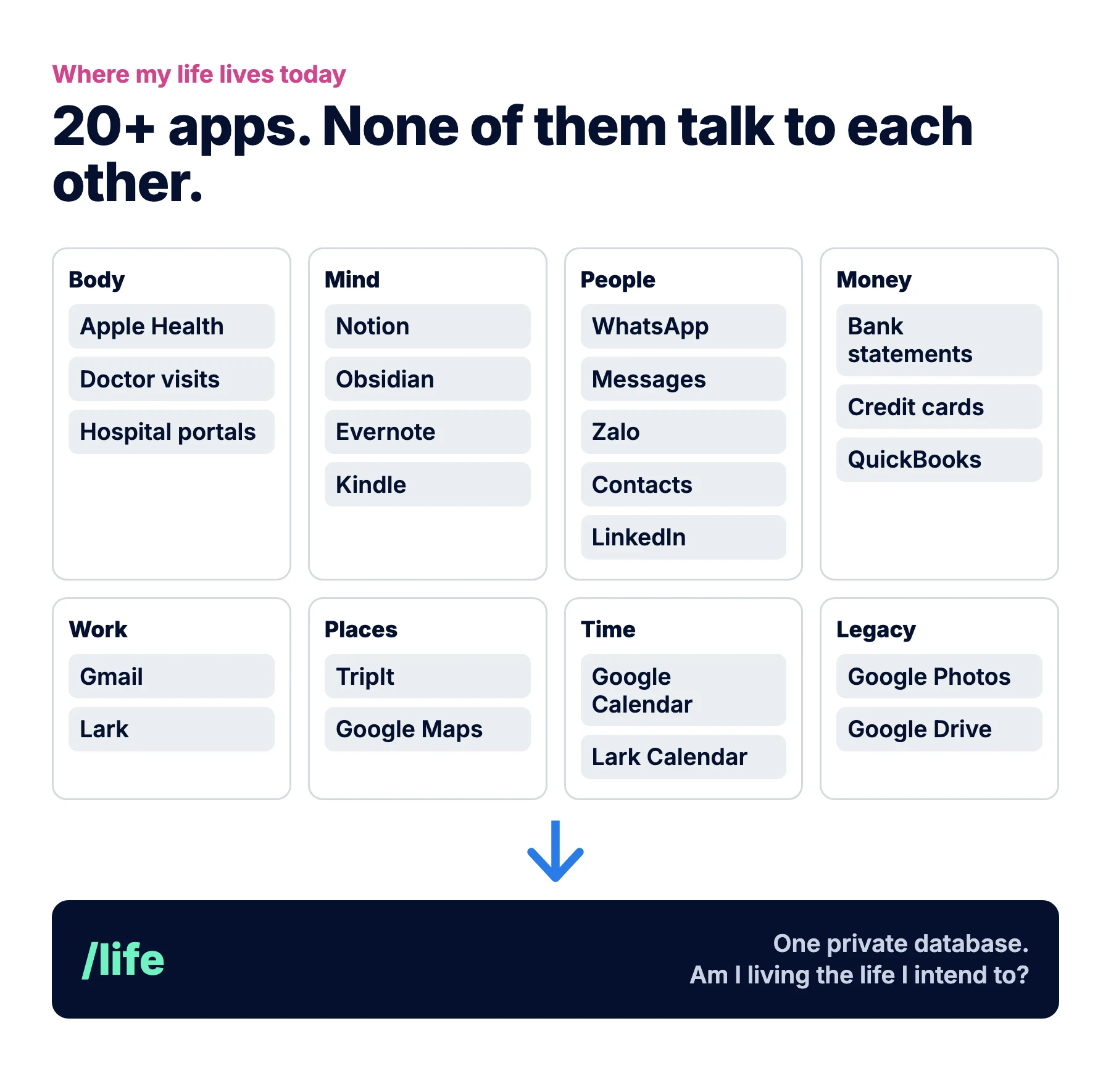
I counted. Here's the roll call:
Journal: Evernote, then Obsidian, then Notion. Pieces of it still live in all three.
Travel: twenty years of flight and hotel confirmations in Gmail. Some of them in TripIt. Some.
Health: doctor visits and surgery records scattered across clinic emails and hospital portals.
Time: a calendar split between Google and Lark.
People: conversations in WhatsApp, Messages and Zalo.
Money: bank statements, credit card statements and QuickBooks.
Everything else: photos in Google Photos, documents in Google Drive.
Every app holds a slice. My watch knows my sleep. My bank knows my money. WhatsApp knows who I actually talk to. Google Photos holds tens of thousands of pictures I will never scroll back through. Notion holds every journal entry and every monthly update I've written for my EO forum since 2021.
None of them talk to each other. And the good stuff lives in the gaps. Sleep against mood. Travel against happiness. Money stress against relationships. You feel those patterns. You never see them.
It's an ocean of data. And you can't drink any of it.
Start with the decisions, not the data
My first draft of this project was wrong. I designed it around the data I already had: journal, trips, medical files. Congratulations, Dave. You built a filing cabinet.
The fix came from the leadership series I teach with Dr. Brooks Holtom at Georgetown. One lesson we keep hammering with executives: don't start with the data you have. Start with the decisions you're trying to make. Work backwards from there, and you almost always discover the data you need was never collected properly in the first place.
True for a company. Turns out, true for a life. Should I take on another market or protect my health this quarter? Who have I let drift that I don't want to lose? Is the travel making me happier, or just busier? Years of journal entries, and not one could answer, because I never put the right numbers next to the words.
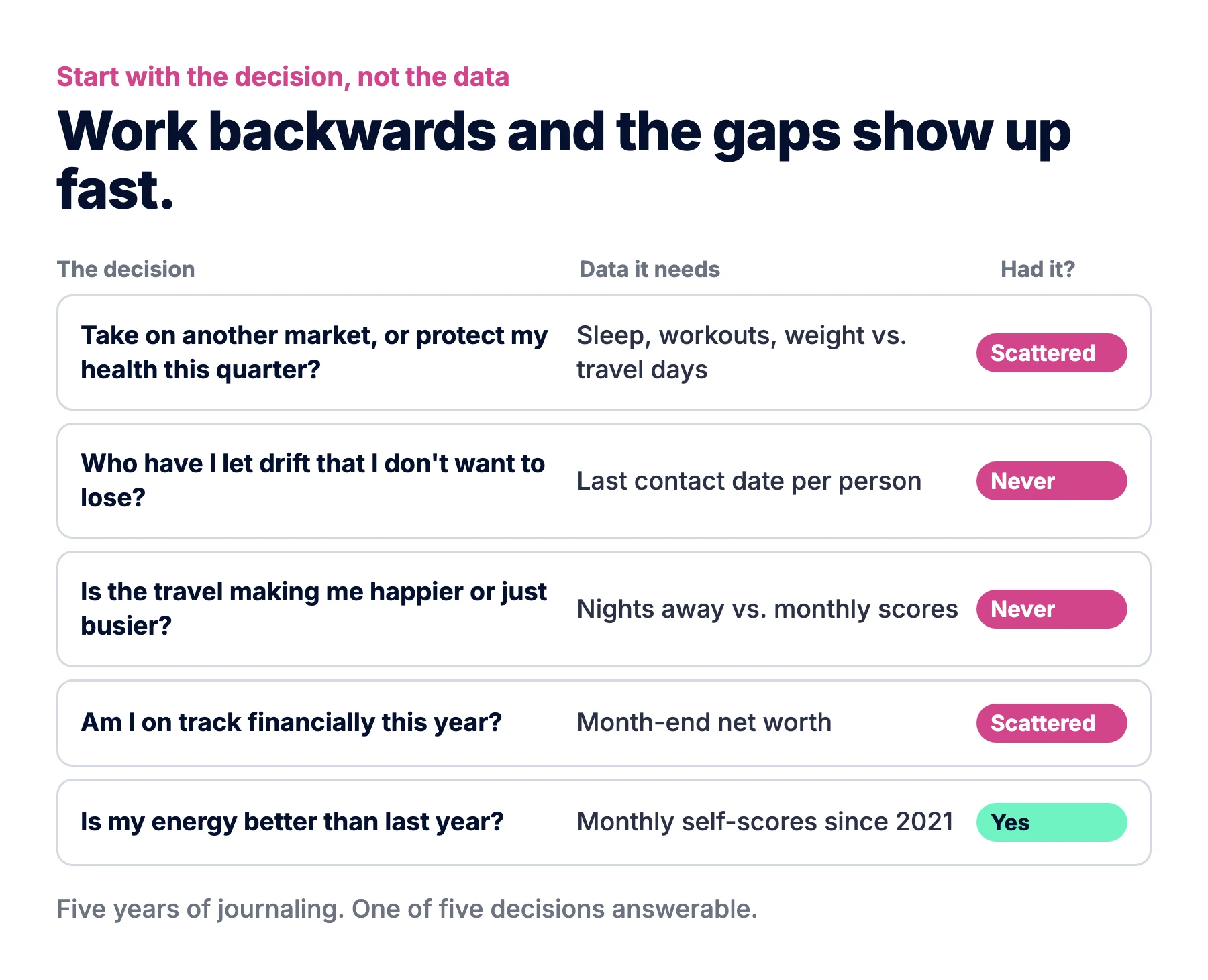
So the real question is what a person should track at all, given the decisions they want to make. I landed on ten areas of a life:
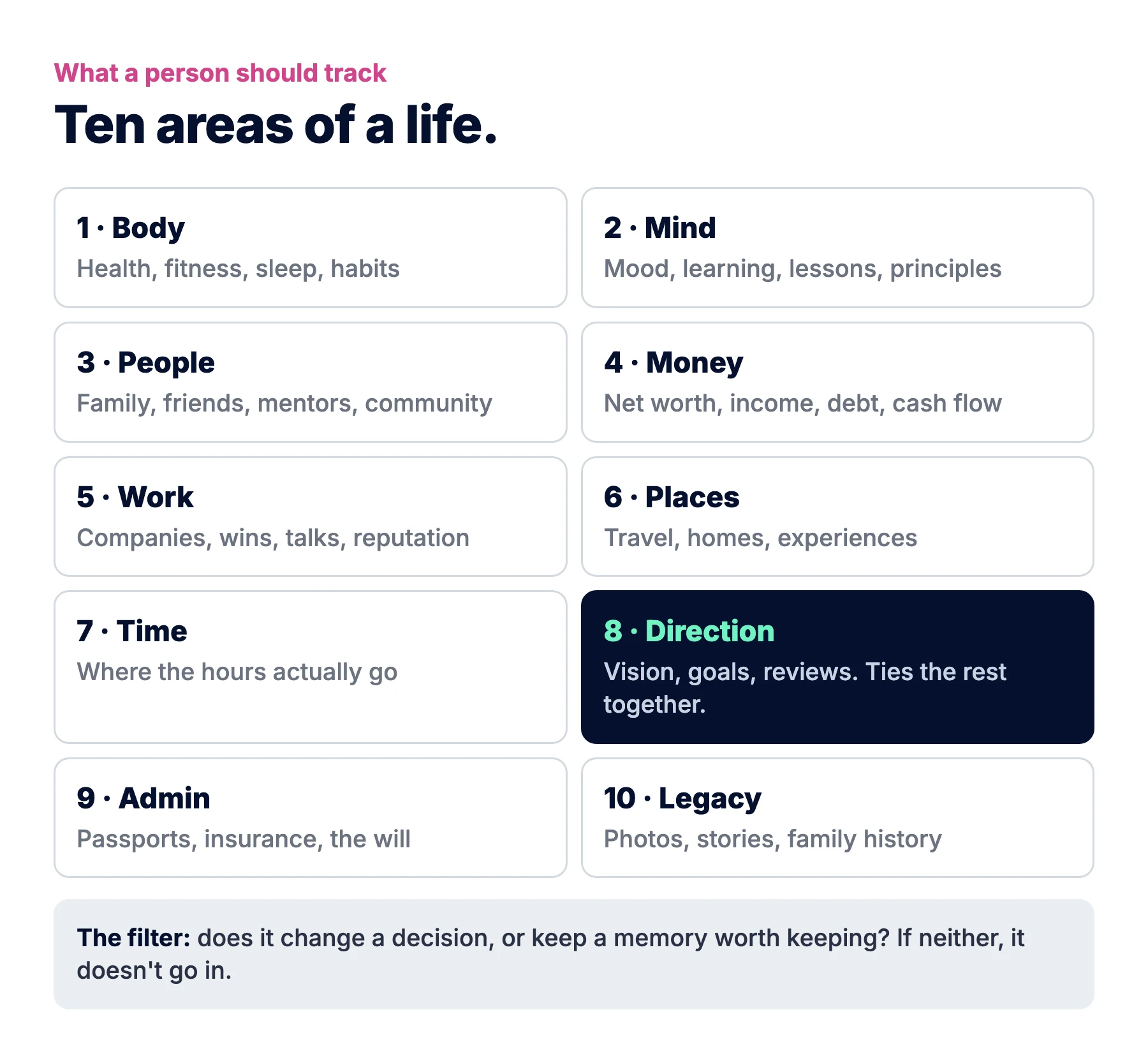
Everything has to get past one bouncer: does it change a decision, or keep a memory worth keeping? If neither, it's not getting in.
Three kinds of data, one loop
Look at it this way and every area holds just three kinds of data. Records (things that happened). Metrics (things measured over time). Reflections (what I thought about it).
Direction sits on top. Goals point at metrics. Metrics prompt reflection. Reflection changes goals. Run it back. That loop is the product. The database is just the beat it rides on.
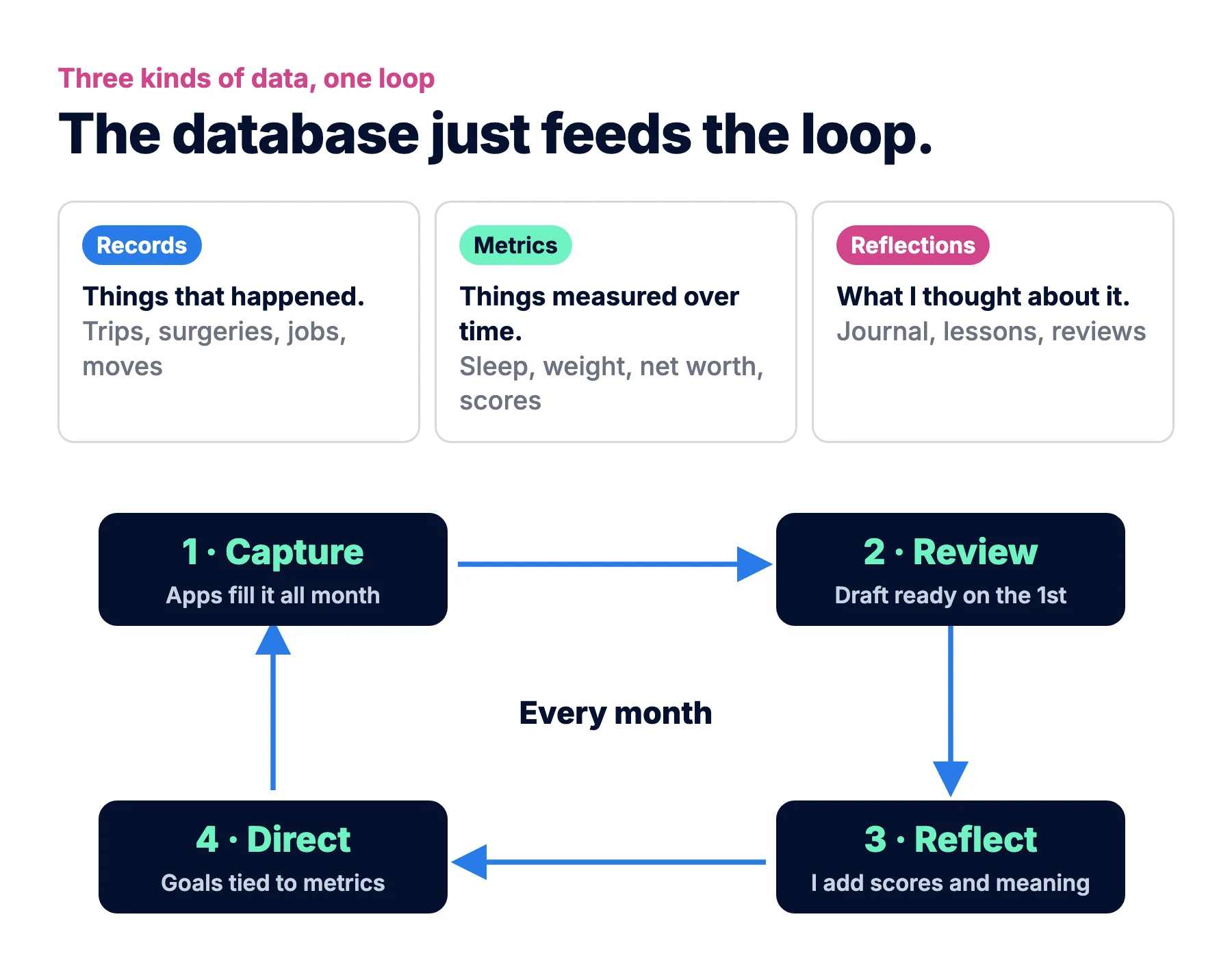
I've been running that loop by hand for five years. Every month I score myself on five dimensions for my forum, pick one word for the month, write my headlines and set 30 and 60-day goals. It works. It also takes an hour, starts from a blank page every single time, and is impossible to compare across years.
So the heart of this thing is a monthly review that fills itself in. On the first of the month, my weight, workouts, sleep, trips, the people I saw and the themes from my journal are already sitting there waiting. I add the scores and the meaning. Ten minutes instead of an hour.
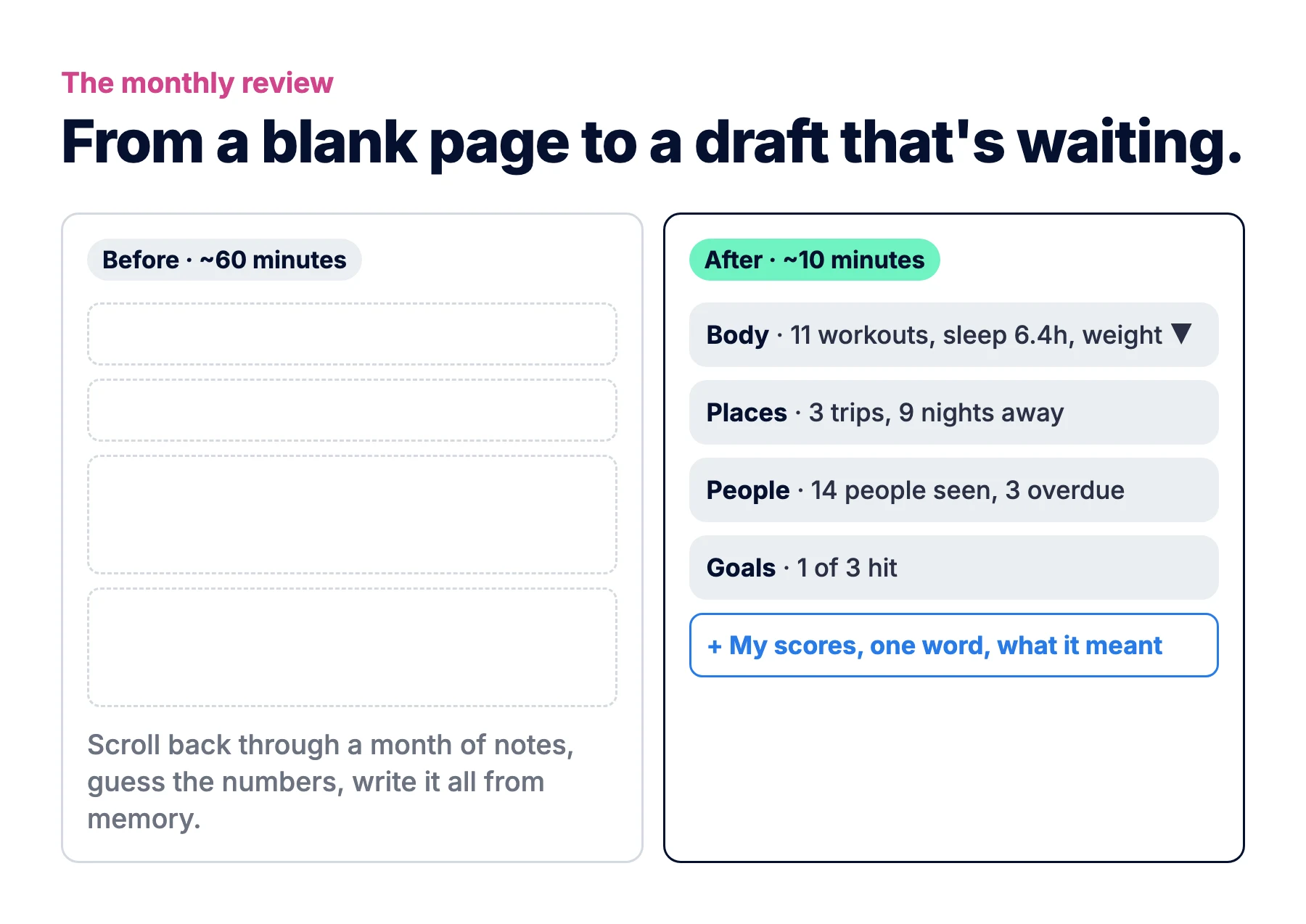
Tracking dies when it's manual. The only thing I should ever type is what only I can know: the score, the meaning, the decision.
How I'm building it (boring on purpose)
I wrote the plan the way I write every AI program for clients, with our 5Ds framework: Definition of the problem, Datasources needed, Diagram and documented workflow, ROI (skipped, this one is personal), and the Deployment plan with a clear definition of done.
The stack is boring on purpose. Boring is exactly what you want holding your surgery records.
Supabase for the database.
A private section of this website for the app.
Claude doing the reading.
A small script inside my Gmail that sends every booking confirmation over, so Claude can turn twenty years of flight and hotel emails into a travel history that works like TripIt. Except the data is mine.
Nightly and morning syncs: my Notion journal every night, Apple Health pushing my body data every morning.
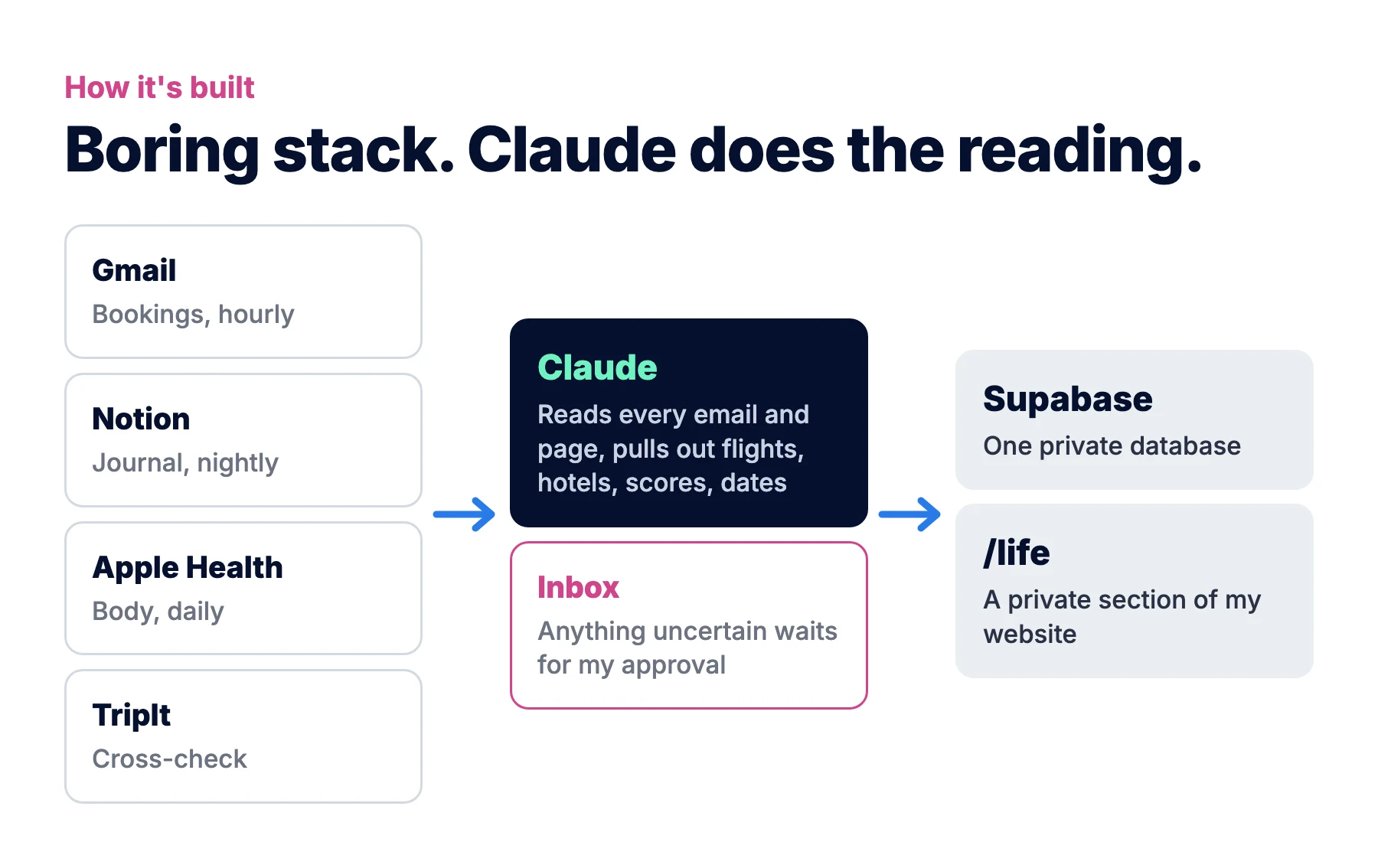
Anything Claude isn't sure about goes into an inbox for me to approve. A wrong date on a medical record is worse than a missing one.
And yes, I built the first version exactly the way I keep telling founders to work: plan first, then multi-delegate. One afternoon. Six AI agents working in parallel on separate parts of the system, each with a clear brief and a definition of done. The plan did the heavy lifting. The agents did the typing.
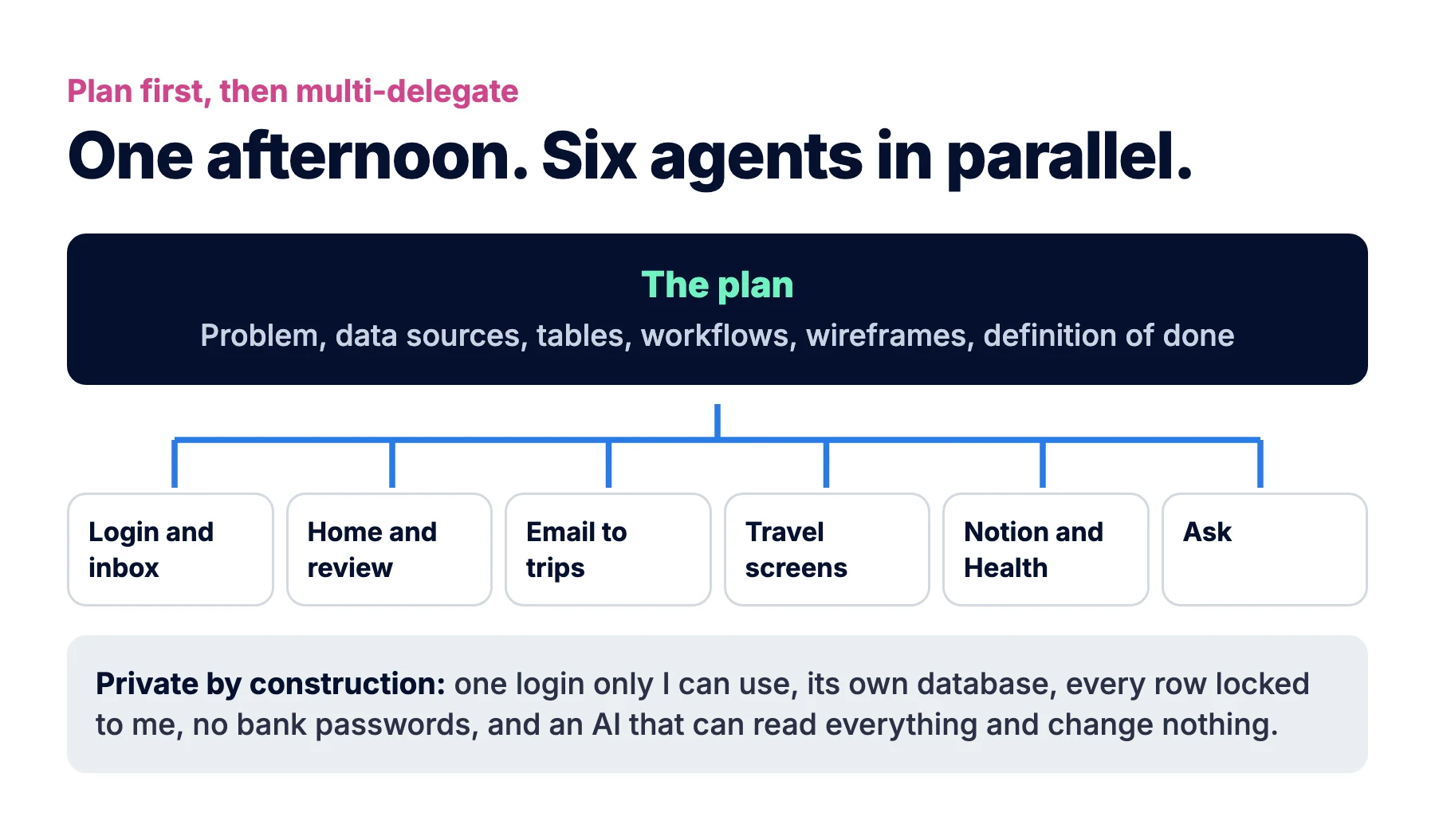
Private by construction
This is the most personal data I have, sitting behind a public website. So the house rules are strict:
One login, and only my email can use it.
Its own database, separate from everything else.
Every row locked to my account.
An AI that can read everything and change nothing.
Bank data from statements only. No passwords stored. Ever.
Read the full plan
I've published the whole thing: the problem, every data source, the database tables, the ten workflows, wireframes for every screen and the definition of done. Read the Personal OS plan here.
I scrubbed my own data out of it. Sorry, no surgery dates for you. The structure is the useful part.
Want one for yourself?
I'm planning to turn this into two things. An open source version, so anyone technical can take the code and run their own. And a small SaaS for people who want the system without the setup.
If either sounds useful, book a discovery call with me. The first people who raise their hand get to shape what it becomes.
Build one or don't. Either way, here's the question I'll leave you with:
If someone asked you today whether you're living the life you intend to, what would you point to as evidence?
Dave.
Things people ask me about this
What is a personal operating system?
A personal operating system is a private database that pulls together the data from every area of your life (health, money, relationships, work, travel, goals) and turns it into a monthly review. Its job is to answer one question: am I living the life I intend to?
What should you track in your personal life?
Track only what changes a decision or keeps a memory worth keeping. A useful frame is ten areas: body, mind, people, money, work, places, time, direction, admin and legacy. Each one holds records, metrics and reflections.
Is it safe to put personal data in a database like this?
Only if it is private by construction: a separate database, a single login only the owner can use, row-level security on every table, no stored bank passwords, and AI access that is read-only.
Will this be open source?
That is the plan. An open source version for people who want to run their own, and a small hosted SaaS for people who want it without the setup.
Let's Work Together
Ready to put AI to work in your business?
Book a call and walk away with a clear view of where AI creates the most leverage for your specific situation.